
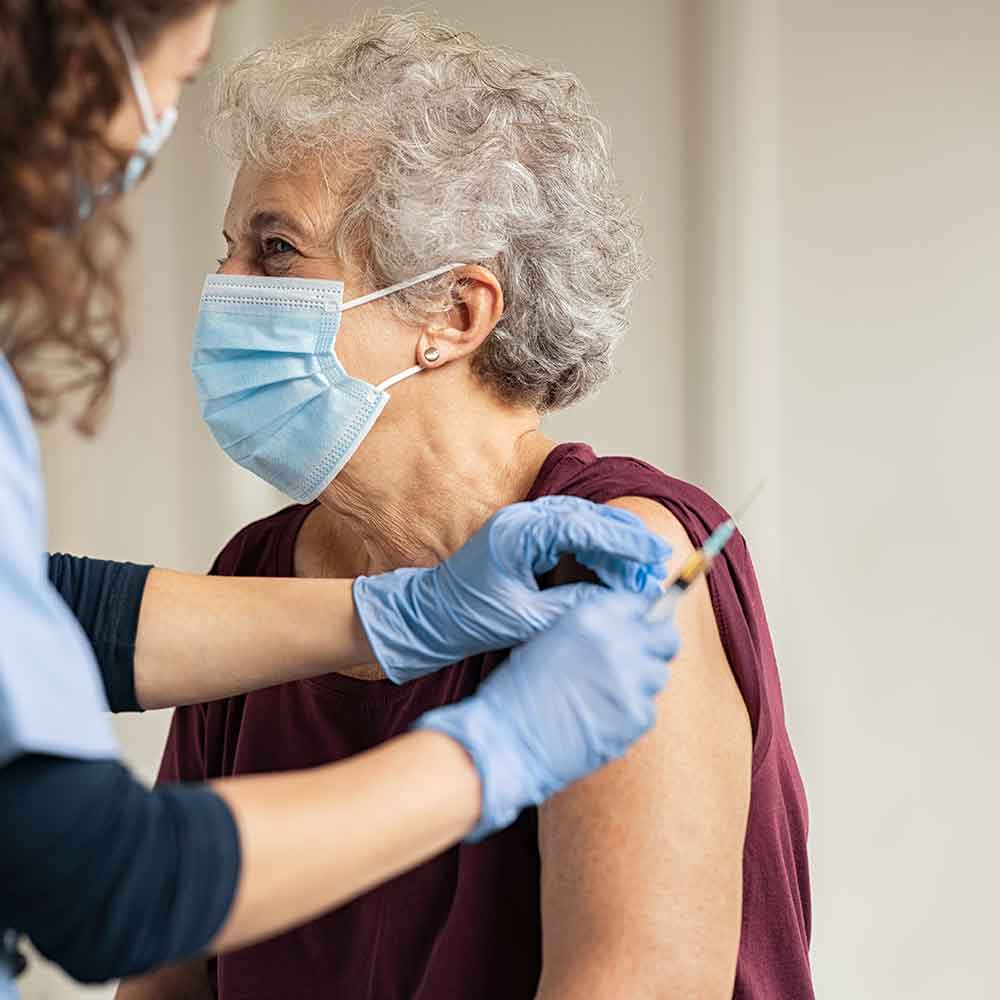
On 1 July 2026, some significant changes were made to the recommendations for pneumococcal vaccination in adults. Considerable changes were also made to the childhood schedule in September last year.
Pneumococcal disease is caused by Streptococcus pneumoniae, a bacterium which commonly colonises the nose and throat. Most carriers remain asymptomatic, but infection can lead to serious disease.
Pneumococcal disease can be classified as either invasive or non-invasive. Non-invasive disease includes otitis media, sinusitis, bronchitis, and non-bacteraemic pneumonia. Invasive pneumococcal disease (IPD) is rare but associated with significant morbidity and mortality. It includes serious infections such as bacteraemia, sepsis, meningitis, and bacteraemic pneumonia.
Groups at highest risk of severe disease include:
- Children <5 years
- Adults ≥65 years
- Aboriginal and Torres Strait Islander people
- People with certain conditions, i.e. immunocompromising conditions or chronic medical conditions (e.g. chronic heart, lung, liver or kidney disease).
Epidemiology in Australia
Invasive pneumococcal disease has been a nationally notifiable disease since 2001. Pneumococcal disease is vaccine preventable. Following the introduction of pneumococcal conjugate vaccines into the National Immunisation Program (NIP), IPD rates fell significantly across all age groups, but particularly in young children. Herd protection has also reduced disease in unvaccinated populations.
In 2025, Australia recorded 2,638 notifications of IPD:
- 369 cases (14%) in children <5 years
- 966 cases (37%) in adults ≥65 years
Despite the success of vaccination programs, pneumococcus remains one of the leading causes of community-acquired pneumonia, meningitis and bacteraemia in Australia. Disease burden remains disproportionately higher among Aboriginal and Torres Strait Islander peoples.
Serotype replacement has occurred following widespread use of conjugate vaccines, whereby disease caused by vaccine-covered serotypes declines but is partly offset by increases in non-vaccine serotypes. This phenomenon informed the development of higher-valency vaccines such as 20vPCV and 21vPCV.
Pneumococcal vaccination
Modern pneumococcal conjugate vaccines (PCV) protect against the pneumococcal serotypes responsible for most severe disease and have significantly reduced vaccine-type IPD.
There are currently two PCVs funded under the NIP: Prevenar 20® (20vPCV) for individuals under 18 years, and Capvaxive® (21vPCV) for eligible adults. However, many other pneumococcal vaccines may be encountered in vaccination histories.
Key Differences
Conjugate vs Polysaccharide
Polysaccharide vaccines do not provoke a strong reaction in children and do not induce anamnestic reactions at any age. Their response occurs primarily via T-cell-independent mechanisms without the establishment of B-cell memory. Pneumovax 23® is an example of a polysaccharide vaccine. Following recent updates to the NIP, Pneumovax 23® is no longer routinely recommended or funded as part of standard pneumococcal vaccination schedules in Australia, having largely been replaced by higher-valency conjugate vaccines.
The other available pneumococcal vaccines are classified as conjugate vaccines. These vaccines contain polysaccharides that have been conjugated onto an immunogenic protein. This stimulates a T-cell dependent immune response along with the establishment of a B-cell memory response.
The advantages of conjugate vaccines include:
- Better immunogenicity
- Longer-lasting protection
- Immunological memory
- Improved responses in older adults and immunocompromised patients
- Reduced nasopharyngeal carriage and herd protection
Serotype coverage
The number in the name of each pneumococcal vaccine refers to the number of serotypes the vaccine covers. There are over 100 serotypes of pneumococci, although not all serotypes cause disease. The predominant serotypes vary by age group and geography with a very small number of serotypes responsible for the majority of disease.
As shown in Table 1, conjugate vaccines are available that cover up to 21 serotypes. While Pneumovax® 23 does cover more serotypes, there has been a shift away from this vaccine towards the newer conjugate vaccines, particularly Prevenar 20® (20vPCV) and Capvaxive® (21vPCV). These newer conjugate vaccines are expected to provide broader protection against currently circulating disease-causing serotypes and more durable immune responses than polysaccharide vaccines, despite covering slightly fewer serotypes than Pneumovax® 23.
Historically, Pneumovax® 23 was used after Prevenar 13® as it covered 10 additional serotypes. However, the newer conjugate vaccines now cover many of the serotypes responsible for current IPD in Australia. For example, Prevenar 20® added seven important serotypes beyond Prevenar 13®; Capvaxive® 21 was specifically developed to target the serotypes causing the greatest burden of adult IPD.
As a result, the incremental benefit of administering Pneumovax® 23 after these higher-valency conjugate vaccines became much smaller.
Table 1. Pneumococcal vaccines commonly seen in Australia
| Vaccine | Vaccine type | Serotypes Covered | Age Registration | Current Australian Use |
| Prevenar 20® (20vPCV) | Conjugate | 20 | ≥6 weeks | NIP-funded for individuals <18 years |
| Capvaxive® (21vPCV) | Conjugate | 21 | ≥18 years | NIP-funded for eligible adults. |
| Vaxneuvance®
(15vPCV) |
Conjugate | 15 | ≥6 weeks | Registered but not NIP-funded. |
| Pneumovax 23®
(23vPPV) |
Polysaccharide | 23 | ≥2 years | No longer routinely recommended |
| Prevenar 13®
(13vPCV) |
Conjugate | 13 | ≥6 weeks | Superseded by newer vaccines. |
Simpler vaccination schedule
Previous vaccine schedules were complex, often requiring a conjugate vaccine (e.g. Prevenar 13®) followed by Pneumovax 23®. There were also multiple revaccination recommendations depending on patient age and presence of risk factors.
Australia’s updated program now uses a single higher-valency conjugate vaccine in most situations, i.e. Prevenar 20® for children and Capvaxive® for adults. The NIP-recommended dosing schedules are:
- Prevenar 20® (20vPCV) for children
- Universal childhood schedule: 1 dose at 2 months, 4 months, and 12 months
- Additional dose at 6 months for Aboriginal and Torres Strait Islander children and children with specified medical risk conditions for pneumococcal disease
- Adolescents with specified medical risk conditions – single dose at diagnosis
- Capvaxive® (21vPCV) for adults
- 18 years and over with specified medical risk condition – dose at diagnosis
- 25 years and over (Aboriginal and Torres Strait Islander adults)
- Adults 65 years and over
Children who started their vaccination course with a lower valency PCV (e.g. Prevenar 13® or Vaxneuvance®) can complete their course with Prevenar 20®.
This simplified schedule may improve adherence, reduce administration errors, and make vaccination programs easier to implement.
Summary
Widespread use of conjugate vaccines has altered circulating pneumococcal serotypes through herd effects and serotype replacement. The Australian Technical Advisory Group on Immunisation (ATAGI) reviewed contemporary disease epidemiology and their recommendations have recently been implemented on the NIP. Changes to the adult schedule include replacing 13vPCV with 21vPCV and lowering the age for vaccination of adults without a risk condition from 70 years to 65 years. Changes to the childhood schedule include replacing 13vPCV with 20vPCV, updating advice for Aboriginal and Torres Strait Islander children so that recommendations are consistent nationally, and removing Pneumovax 23® from the recommendations for higher risk children.
References:
- Australian Centre for Disease Control. National Notifiable Disease Surveillance System. 2026.
- Australian Medicines Handbook(online). Adelaide: Australian Medicines Handbook Pty Ltd; 2026 July. Available from: https://amhonline.amh.net.au/
- Australian Technical Advisory Group on Immunisation (ATAGI). Australian Immunisation Handbook. Australian Government Department of Health and Aged Care: Canberra; 2026. Available from: https://health.gov.au
- Golos M, Eliakim‐Raz N, Stern A, Leibovici L, Paul M. Conjugated pneumococcal vaccine versus polysaccharide pneumococcal vaccine for prevention of pneumonia and invasive pneumococcal disease in immunocompetent and immunocompromised adults and children. Cochrane Database Syst Rev. 2019; 2019(2): CD012306.
- National Centre for Immunisation Research and Surveillance [Internet]. Sydney: NCIRS; 2026 [cited 2026 Aug 6]. Available from: https://ncirs.org.au
Subscribe Knowledge Centre Updates
Enter your details to receive Knowledge Centre updates